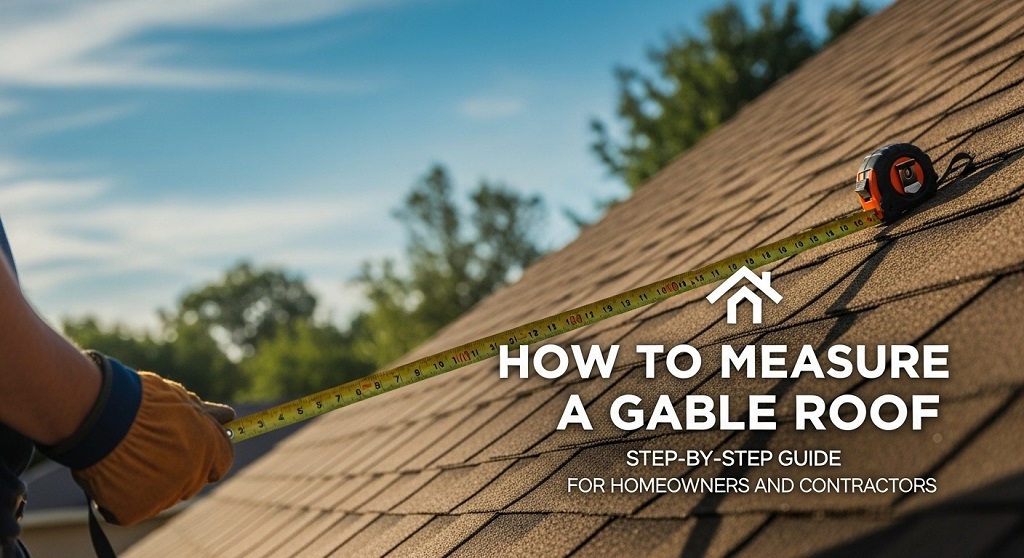
A simple gable roof looks easy from the ground, but getting exact measurements can feel overwhelming the first time you climb the ladder. Whether you plan to replace shingles, install solar panels, or just get an accurate roofing quote, knowing the real square footage and pitch saves thousands in mistakes. According to the U.S. Census Bureau’s latest housing data, over 65% of American single-family homes built after 1990 have gable-style roofs. Yet the National Roofing Contractors Association reports that incorrect measurements cause more than 40% of material overages or shortages on residential jobs. This guide walks you through every step so you finish the job right the first time.
What Exactly Is a Gable Roof and Why Measurement Matters
A gable roof features two sloping sides that meet at a central ridge, forming triangular “gables” at each end. Builders love it because water and snow slide off easily, and homeowners love the classic look.
Accurate measurements matter more than most people think. Roofing materials, underlayment, flashing, and even ventilation calculations all depend on precise square footage and pitch. One small error compounds quickly when you multiply by bundles of shingles or sheets of metal.
Essential Tools You Need Before Climbing the Ladder
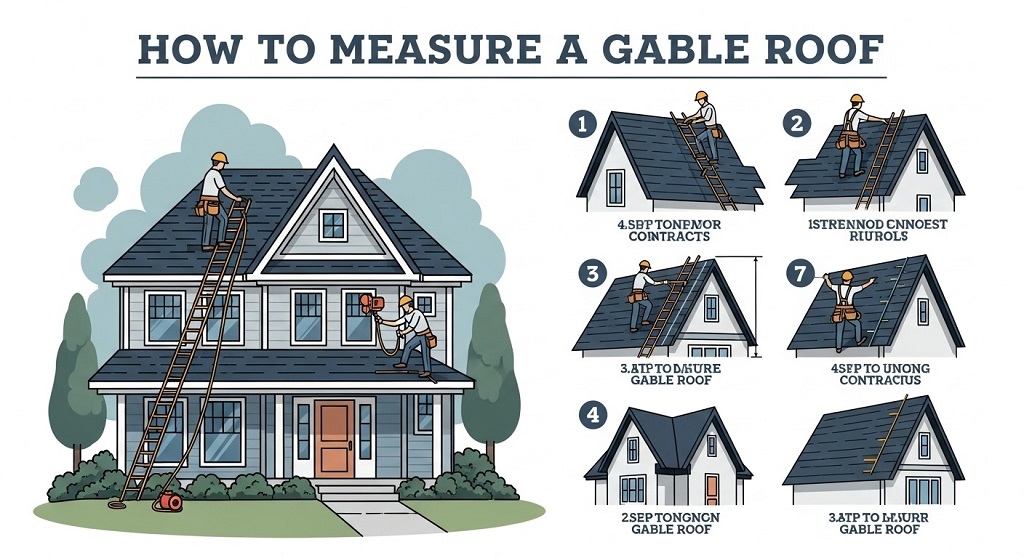
Gather these tools first. Trying to improvise halfway up costs time and raises safety risks.
- 100-foot tape measure (or laser distance measurer)
- 25–50 foot secondary tape for width
- Pitch gauge or smart phone with clinometer app
- Sturdy extension ladder rated for your weight plus tools
- Chalk line and carpenter’s pencil
- Safety harness and roof brackets (strongly recommended)
- Calculator or roofing app
Modern laser measurers now read to 1/16 inch from the ground in many cases, but nothing replaces hands-on verification for complex roofs.
Understanding Roof Pitch: The Most Important Number
Pitch describes how steep the roof rises for every 12 inches of horizontal run. Professionals write it as “6/12” or “6:12,” meaning the roof rises 6 inches vertically for every 12 inches horizontally.
Common gable roof pitches range from 4/12 (walkable) to 12/12 (very steep). The Asphalt Roofing Manufacturers Association states that pitch directly affects material choice, labor time, and safety requirements.
Quick Ways to Find Pitch from the Ground
- Use a construction calculator app and hold your phone against the roof plane.
- From the attic, place a level 12 inches out from the rafter and measure upward to the underside.
- Count exposed shingle butts if the roof has standard 5-inch exposure—multiply by three for approximate rise.
Measuring Pitch on the Roof (Most Accurate)
Extend a 12-inch level from the roof surface. Hold it perfectly horizontal (use the bubble). Measure straight up from the 12-inch mark to the roof. That distance becomes the numerator (example: 7 inches = 7/12 pitch).
Step-by-Step: Measuring Ground Dimensions First
Start safe—stay on the ground whenever possible.
- Sketch the entire house footprint. Mark every gable end, overhang, chimney, and dormer.
- Measure the length of the house parallel to the ridge (usually the longest side).
- Measure the width perpendicular to the ridge at both ends and in the middle—walls sometimes bow.
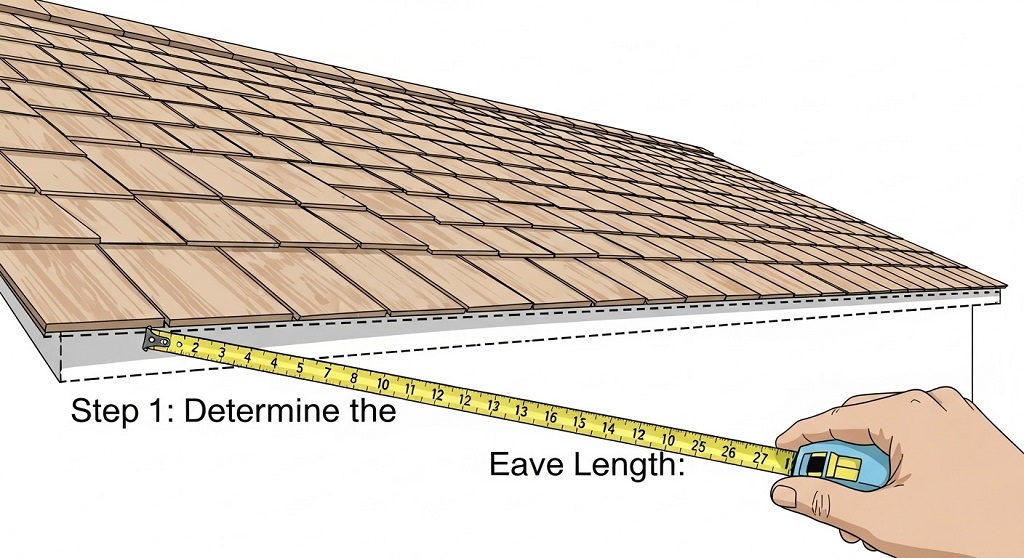
- Add overhangs on all sides. Typical eaves extend 12–24 inches; rakes on gable ends usually match or exceed that.
Multiply length × width to get the ground-plane rectangle. This becomes your baseline.
Calculating Slope Factor (The Magic Multiplier)
Every pitch has a slope factor that converts ground area to actual roof surface area.
| Pitch | Slope Factor | Pitch | Slope Factor |
|---|---|---|---|
| 4/12 | 1.054 | 9/12 | 1.250 |
| 5/12 | 1.083 | 10/12 | 1.302 |
| 6/12 | 1.118 | 11/12 | 1.356 |
| 7/12 | 1.158 | 12/12 | 1.414 |
| 8/12 | 1.202 |
Simply multiply your ground rectangle by the correct factor. A 30 ft × 50 ft house (1,500 sq ft ground) with 7/12 pitch needs 1,500 × 1.158 = 1,737 actual roof square feet.
Measuring the Roof Directly: When Ground Numbers Aren’t Enough
Complex roofs with hips, valleys, dormers, or multiple gable sections demand direct measurement.
Break the Roof into Rectangles and Triangles
Divide everything into simple shapes on your sketch. Measure each plane separately.
- Run a tape from eave to ridge on several rafters—average the lengths.
- Measure the horizontal run along the eave for each section.
- Multiply length × width for rectangles.
- For gable-end triangles: (base × height) ÷ 2.
Add every section together. Double-check by measuring the same plane two different ways.
Accounting for Roof Overhangs and Rakes
Never forget overhangs—they add surprising area.
Standard calculation: Overhang length × total perimeter of the house ÷ 2 (since only eaves and rakes count, not walls with gutters only).
Many pros simplify: measure one typical rake board length, then multiply by total linear feet of rake edges.
Adding Waste Factor: Real-World Roofing Math
No roof installs perfectly. Include waste upfront.
- Architectural shingles on 4/12–6/12 pitch: add 10–12%
- Steeper than 8/12 or three-tab shingles: add 15–18%
- Heavy cuts around valleys, hips, or dormers: add up to 25%
Example: 2,000 sq ft roof at 7/12 with moderate complexity = 2,000 × 1.15 = 2,300 sq ft ordering total (23 squares).
How to Measure for Specific Materials
Different materials need slightly different calculations.
Asphalt Shingles
Order by the “square” (100 sq ft). Always round up to full bundles—most brands pack three bundles per square.
Metal Roofing
Measure exact panel lengths from eave to ridge plus overhang. Width coverage varies by profile (usually 36–39 inches exposed).
Solar Panel Layout
Panels require perfectly flat planes. Measure usable area only—subtract 18 inches from edges and 36 inches around chimneys or vents.
Safety Rules You Must Follow
Falls remain the top cause of roofing injuries. The Occupational Safety and Health Administration reports over 30 roofing fatalities yearly in the U.S. alone.
Key rules:
- Use a harness tied to a secure anchor any time the pitch exceeds 6/12.
- Install roof brackets or jack lines on steep roofs.
- Never walk on a wet or frosty roof.
- Have a spotter on the ground.
Double-Check Your Numbers: The Pro Verification Method
Experienced roofers always verify three ways:
- Ground measurement × slope factor
- Direct on-roof plane measurements
- Drone or satellite imagery cross-check (modern tools now accurate within 2%)
When all three methods agree within 3–5%, you can trust the total.
Related Topics: Dunavant Snow Splitter for Metal Roofs
Common Mistakes Beginners Make (And How to Avoid Them)
Forgetting to measure both roof faces separately on cross-gable designs. Measuring only to the fascia instead of including overhang. Using the wrong slope factor (huge cost impact). Ignoring starter strip and ridge cap quantities. Rounding down instead of up—running short mid-job costs far more than extra material.
Related Topics: How to Permanently Stop Roof Algae Streaks
Conclusion: Take Control of Your Roofing Project
Measuring a gable roof combines simple math with careful observation. Start with an accurate sketch, determine pitch correctly, measure ground dimensions plus overhangs, apply the right slope factor, and add realistic waste. Do the work once, do it right, and you eliminate expensive surprises.
Grab your tape measure this weekend, follow the steps above, and create your own professional-grade roof measurement. You’ll gain confidence, save money, and impress any contractor you hire later.
Ready to measure your roof like a pro? Download a free printable roof measurement worksheet, climb safely, and get exact numbers today!
FAQs
How do I measure a gable roof from the ground only?
Use a laser distance measurer or long tape to get length and width including overhangs, determine pitch with a phone app or from the attic, then multiply ground area by the slope factor for your pitch. Accuracy reaches 95–98% on simple gables.
What pitch is considered a “steep” gable roof?
Most contractors classify anything over 8/12 as steep and 10/12 or greater as very steep, requiring additional safety gear and often different underlayment.
Do I measure both sides of the gable roof separately?
On a simple symmetric gable, both planes are identical, so measure one and double it. On cross-gables or irregular designs, measure every plane individually.
How many squares is an average gable roof?
Typical 2,000–2,500 sq ft ranch homes have 22–30 squares of actual roof surface (including pitch and waste). Larger two-story homes often reach 40–60 squares.
Can I use Google Earth to measure my gable roof?
Satellite imagery works well for ground dimensions and rough estimates, but it cannot determine pitch accurately and often misses overhangs. Use it as a starting point only.
References
- U.S. Census Bureau – Characteristics of New Housing: https://www.census.gov/construction/chars/current.html
- National Roofing Contractors Association – Roofing Practices Guide: https://www.nrca.net
- Asphalt Roofing Manufacturers Association – Technical Bulletins: https://www.asphaltroofing.org
- OSHA Fall Protection Standards for Roofing: https://www.osha.gov/roofing