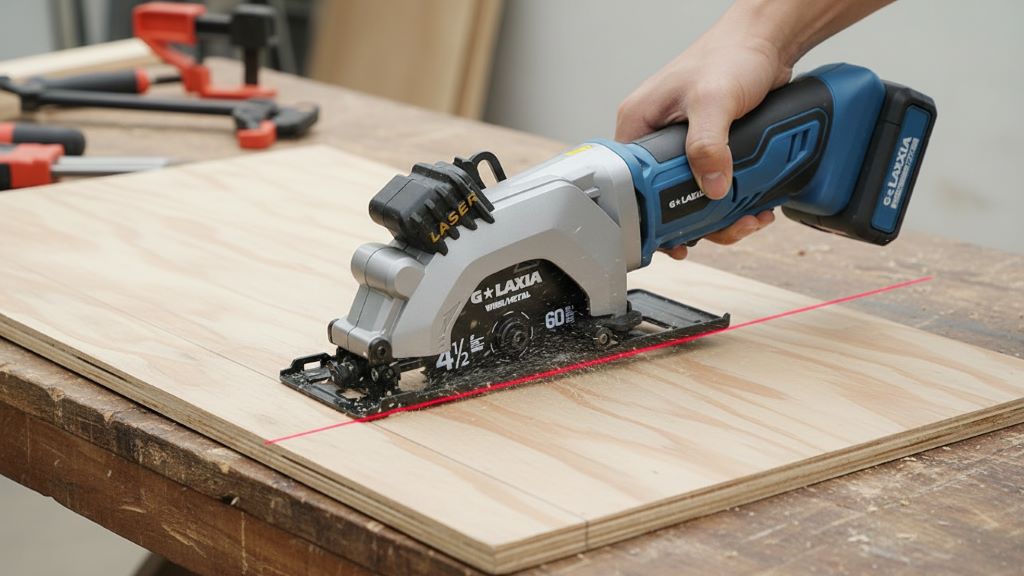
Buying a mini circular saw in 2025 feels simple—until you realize most compact saws fall into one of two camps: lightweight but weak, or powerful but awkward to control. The G LAXIA Mini Circular Saw aims to sit in the sweet spot, with a compact build, laser guidance, and specs that promise “real saw” capability in a smaller footprint.
This product review breaks down what the tool does well, where it falls short, and who should actually spend money on it this year.
What this saw is (and isn’t)
The G LAXIA Mini Circular Saw targets DIYers, installers, and homeowners who need clean, controllable cuts in tighter spaces, not the brute-force capacity of a full 7-1/4 inch circular saw. Based on manufacturer-style documentation for this class of mini saws, a typical configuration uses a 115 mm (4-1/2 inch) blade, supports bevel cuts up to 45°, and includes a dust extraction port designed to connect to a vacuum adapter for better debris control.
It also focuses on guided accuracy—laser alignment and a rip guide show up repeatedly in product descriptions and manuals for this model family, and those features matter most when you need repeatable straight cuts on sheet goods, trim, and small panels.
What it isn’t: a framing saw replacement. Even if a mini saw spins fast, its blade diameter and cutting depth inherently limit what it can do on thick lumber and stacked materials, according to widely accepted industry standards around circular saw selection.
Key specs and core features (what matters in real work)
Mini saws live or die by a few practical specs: speed, cutting depth, adjustability, handling, and safety controls. The available documentation for this tool format highlights these points.
Motor speed and cutting capacity
Manufacturer documentation for a comparable G LAXIA mini circular saw manual lists a no-load speed of 3500 RPM, paired with a 115 mm blade size. It also lists a maximum cutting depth of 42.8 mm at 90° and 28 mm at 45°, which translates to roughly 1-11/16 inches and about 1-1/8 inches respectively—common targets for mini saws in this category.
In plain terms, that depth range works well for:
- Plywood and OSB panels.
- Laminate flooring planks.
- MDF and thin boards.
- Trim stock and craft lumber.
It becomes limiting for:
- 2x lumber (especially if you want to cut in a single pass).
- Thick hardwood slabs.
- Deep bevel cuts through dense materials.

Laser guide + rip guide (accuracy tools)
The manual for this style of mini circular saw includes a laser function with alignment steps (mark cut line, start motor, let blade reach speed, then align laser with the mark and push forward steadily). That workflow matches how professionals recommend using laser guides: as an alignment aid, not as a substitute for measuring, clamping, and maintaining a straight feed.
A rip guide (edge guide) also comes up in the same documentation set, and it matters because it turns “freehand” cuts into repeatable, parallel cuts—useful for shelf sizing, flooring undercuts, and consistent strip ripping.
Dust extraction port + vacuum adapter
This model format typically includes a dust extraction port and vacuum adapter instructions (connect adapter to the tool’s dust port and attach to a vacuum hose). In practice, dust control is one of the biggest quality-of-life wins with compact saws because you often use them indoors (flooring, cabinetry tweaks, garage projects).
Based on manufacturer guidelines, always confirm the dust path stays clear; fine dust buildup can reduce extraction effectiveness and can also affect guard movement over time.
Safety systems and handling
Industry-standard circular saw safety guidance emphasizes:
- A properly functioning lower blade guard that closes instantly.
- Start-prevention features (lock-off or two-step triggers).
- Firm, two-hand control whenever possible.
Documentation for this mini saw category highlights a lock-off style switch and standard circular saw kickback warnings, including guidance like keeping hands away from the cutting area, using proper blade depth (often no more than about 1/4 inch below the material), and avoiding dull blades that increase binding risk.
Design and ergonomics: why mini saws feel “easier” (and when they don’t)
A mini circular saw usually feels easier to steer because it weighs less and fits into tighter angles than a full-size saw. In user-facing 2025 review coverage, the G LAXIA Mini Circular Saw gets described as compact and portable and paired with a soft rubber handle intended for one-handed comfort, plus a double protection switch to reduce accidental starts.
That said, “small” does not automatically mean “safe” or “effortless.” Mini saws can encourage casual use—quick cuts without clamping—because they look less intimidating. According to widely accepted industry standards, control and workpiece stability matter more than tool size. If the material shifts, the saw can still bind, kick back, or tear out edges.
Practical setup tips (as recommended by professionals):
- Clamp the workpiece every time, even for short cuts.
- Use a sacrificial board under sheet goods.
- Set depth so the blade barely clears the underside.
- Let the saw reach full speed before contacting the material.
Performance test: what to check before trusting it on a project
A good mini circular saw should cut straight, start smoothly, maintain speed under reasonable load, and leave a manageable cut edge with the included blade. Instead of relying on hype, run a simple performance test at home before committing it to finish work:
- Start-up and stability test
Start the saw off the material and listen for smooth ramp-up and steady tone at full speed. Based on manufacturer-style guidance, allow a brief moment for the blade to reach maximum speed before cutting.
- Straight cut test (rip guide)
Use the rip guide on plywood or MDF and make a 24–36 inch cut. Check whether the guide holds position and whether the saw drifts.
- Bevel cut test (45°)
Set bevel to 45° and cut a shorter piece of plywood. Confirm the bevel lock stays tight and the base plate holds its angle.
- Tear-out check
Inspect the top surface and bottom surface. Mini saws can tear fibers on thin veneers; painter’s tape and a finer-tooth blade often help, according to professional shop practice.
- Dust control check
Connect a vacuum and verify the port actually captures dust during a long rip. If dust sprays everywhere, re-seat the adapter and confirm the hose doesn’t kink.
This approach gives practical value because it tells you whether your specific unit, blade, and technique produce job-ready results—without guessing.
Blade selection: the hidden factor that changes everything
Most disappointing “tool” reviews actually describe a blade problem. Manufacturer documentation for this mini saw format lists different blade types for different materials (for example, TCT for wood/plastics, HSS for thin non-ferrous sheet metal, and a diamond blade for tile-like materials).
Actionable guidance (based on manufacturer guidelines and professional recommendations):
- Use a dedicated blade for the material—don’t “make do” with the wrong one.
- Replace the blade sooner than you think; small blades dull faster when pushed hard.
- Keep feed rate steady; forcing the saw increases heat, chatter, and rough edges.
- For clean laminate cuts, use a fine-tooth blade and score the top layer first when possible.
If buying this saw for 2025 DIY work, budget for at least one upgraded blade matched to your main use (fine plywood, laminate, or trim). That single change often improves cut quality more than any feature like lasers or guides.
Related:
Gable Roof Framing for Small Homes
Minneapolis Pipe Thaw: Cool Solutions for Warm, Clog-Free Drains
Customer experience: what owners usually like (and what frustrates them)
When people choose a mini circular saw, they usually want three outcomes: less fatigue, more control, and fewer “big-saw” hassles. In 2025 review-style coverage for the G LAXIA Mini Circular Saw, the tool gets positioned around portability, guided cutting (laser + rip guide), and a kit-like package that includes multiple accessories so you can start quickly.
Common positives in real-world customer experience tend to include:
- Easier handling on small stock and awkward cuts.
- Better comfort for quick indoor jobs (flooring, shelving, trim).
- Faster setup for small projects than pulling out a larger saw.
Common frustrations (typical for the category and consistent with industry expectations):
- Limited depth of cut—especially at bevel.
- Slower progress through dense wood if you push it like a full-size saw.
- Laser usefulness depends on lighting, calibration, and technique.
The key takeaway: satisfaction rises when buyers treat it as a precision compact tool—not as a “mini version” of a framing saw.
Who should buy it in 2025?
This tool makes sense in 2025 if you value control and portability over maximum cutting depth, and if you often cut thin to medium materials.
Good fit for:
- DIY homeowners doing repairs, flooring, shelving, and trim work.
- Apartment/indoor users who want a smaller tool with dust-port potential.
- Makers who cut plywood, MDF, acrylic sheets, or thin boards.
Not a great fit for:
- Framing and heavy construction.
- Thick hardwood cutting all day.
- Users who need deep bevel cuts through thick stock.
According to widely accepted industry standards, choosing the right saw depends more on material thickness and cut volume than on brand—so buy this only if its cutting depth matches your most common jobs.
Pros and cons (practical, not hype)
Pros
- Compact size supports better control for detail cuts and tight spaces.
- Laser and rip guide support straighter cuts when set up properly.
- Dust extraction port and vacuum adapter option improve cleanliness.
- Adjustable depth and bevel settings increase versatility.
Cons
- Cutting depth limits thick lumber work.
- Cut quality depends heavily on blade choice and technique.
- Laser alignment helps, but it won’t correct poor measuring or workpiece movement.
FAQs
Is the G LAXIA Mini Circular Saw strong enough for 2x4s?
It can cut 2x material in some cases, but its max cutting depth (about 1-11/16 inches at 90° in typical documentation for this model class) often prevents clean single-pass cuts through thicker boards. For frequent 2x cuts, professionals usually recommend a full-size circular saw.
Can it cut tile or metal?
Manufacturer-style documentation for this mini saw format lists different blades for different materials (TCT for wood/plastic, HSS for thin non-ferrous sheet metal, diamond blade for tile-like materials). Always match the blade to the material and follow safety practices for sparks and dust.
Does the laser make cuts perfectly accurate?
A laser can help you track a line, but accuracy still depends on measuring, clamping, steady feed rate, and keeping the base plate flat. Industry guidance treats laser guides as assistive—not as precision measurement tools.
How do you reduce tear-out on plywood?
Use a fine-tooth blade, apply painter’s tape along the cut line, support the sheet fully, and feed steadily. Professionals also recommend cutting with the “good face” down or up depending on blade direction and saw design.
What’s the safest depth setting?
Manufacturer safety guidance for circular saws often suggests setting depth so only a small portion of the tooth extends below the material (commonly around 1/4 inch). This reduces kickback risk and improves control.
Is a mini circular saw safer than a full-size saw?
It can feel easier to control due to size and weight, but it still carries the same core hazards (kickback, blade contact, debris). Follow standard circular saw safety rules regardless of tool size.
Conclusion: Is it worth buying in 2025?
Yes—if you need a compact saw for controlled, repeatable cuts in sheet goods, trim, and DIY materials, and you accept the depth limits that come with a 4-1/2 inch class blade. Treat it like a precision helper tool, pair it with the right blade, and run a quick performance test before using it on finish surfaces.
If your projects mainly involve plywood, laminate, MDF, and small boards, consider adding the G LAXIA mini circular saw to your 2025 toolkit and upgrade the blade first for the best results.