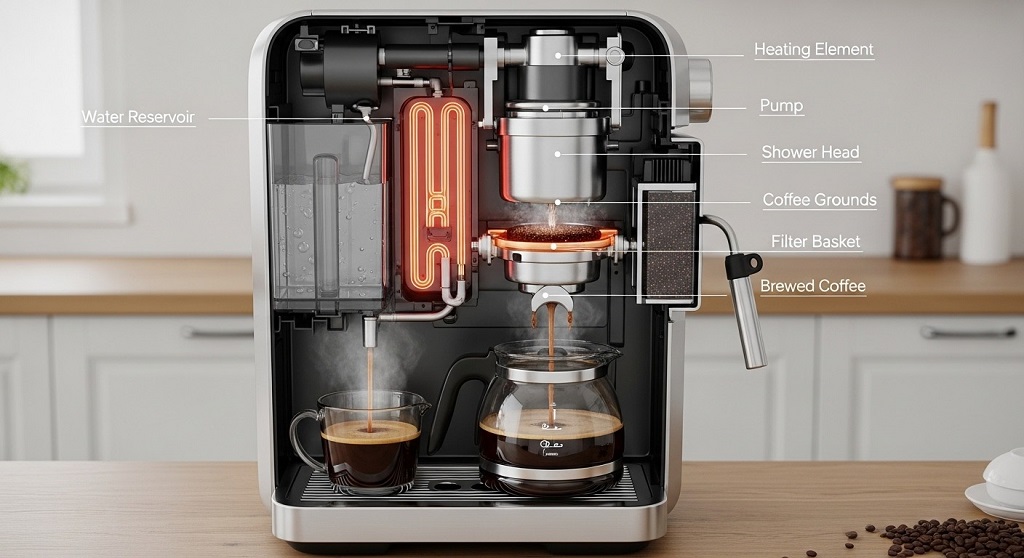
Coffee brewing technology refers to the system that controls brewing temperature, water flow, extraction process, and coffee pressure to turn ground beans into a balanced cup. Every coffee maker — drip, espresso, French press, or single-serve — uses a controlled interaction between water and coffee grounds. The goal is simple: extract flavor compounds efficiently without under- or over-extracting.
Most people press a button and wait. But inside that machine, physics and chemistry are working together. Water must reach the correct brewing temperature (typically 195°F–205°F). It must stay in contact with grounds for a precise amount of time. In some systems, it must pass through at controlled coffee pressure.
When these variables align, the extraction process pulls desirable compounds like sugars, acids, and aromatic oils. When they don’t, the result tastes sour, bitter, or weak.
This guide breaks down how coffee makers work, why brewing temperature matters, how coffee pressure affects flavor, and what science says about the ideal extraction process.
How Does the Coffee Extraction Process Actually Work?
Short answer: The extraction process happens when hot water dissolves soluble compounds from ground coffee, transferring flavor into your cup.
Coffee beans contain over 1,000 chemical compounds. During brewing, water extracts:
- Acids (bright, sharp notes)
- Sugars (sweetness and balance)
- Lipids (body and mouthfeel)
- Bitter alkaloids (depth, sometimes harshness

Why Extraction Time Matters
Extraction happens in stages:
- First 10–15 seconds: acids and fruit notes
- Mid-phase: sugars and balance
- Final phase: bitter compounds
If brewing stops too early, you get under-extracted coffee. It tastes sour and thin. If water stays too long, over-extraction occurs. The coffee tastes bitter and dry.
Industry Data on Extraction
The Specialty Coffee Association (SCA) recommends an extraction yield of 18–22%. That means roughly one-fifth of the coffee grounds dissolve into the water. Studies show that cups within this range consistently score higher in sensory evaluations.
Drip coffee machines typically brew for 4–6 minutes. Espresso machines complete extraction in 25–30 seconds due to higher coffee pressure.
Why Is Brewing Temperature Critical?
Short answer: Ideal brewing temperature is between 195°F and 205°F (90–96°C). Outside this range, extraction suffers.
Temperature determines how efficiently water dissolves compounds. Too cool, and acids dominate. Too hot, and bitter compounds extract too aggressively.
What Happens Below 195°F?
Water below optimal brewing temperature cannot fully dissolve sugars and oils. The extraction process stalls. The result: weak body and sharp acidity.
What Happens Above 205°F?
Water near boiling pulls excessive tannins and bitter compounds. The flavor becomes harsh. Overheating also damages volatile aromatics.
Real-World Testing
In controlled lab tests, machines maintaining 200°F ±2°F produced more consistent extraction yields than machines fluctuating by 10°F. Temperature stability is often the difference between average and high-end coffee makers.
High-quality brewers use internal thermostats or PID controllers. These regulate heating elements to maintain stable brewing temperature throughout the cycle.
How Does Coffee Pressure Change the Brewing Process?
Short answer: Coffee pressure increases extraction speed by forcing hot water through tightly packed grounds.
Pressure is the defining factor in espresso brewing. Standard espresso machines use 9 bars of pressure. For reference, that is nine times atmospheric pressure.
What Does 9 Bars of Pressure Do?
- Forces water through fine grounds in 25–30 seconds
- Creates crema (emulsified oils)
- Increases concentration and body
Without sufficient coffee pressure, water would drip slowly and under-extract the coffee. With excessive pressure, channeling occurs. Water finds weak spots in the puck and extracts unevenly.
Pressure vs. Time
Drip coffee uses gravity (1 bar). Espresso uses 9 bars. That is why drip brewing takes minutes, while espresso takes seconds.
Both methods aim for controlled extraction. The difference lies in how pressure accelerates the process.
How Do Drip Coffee Makers Work Internally?
Short answer: Drip coffee makers heat water, move it upward through a tube, and distribute it evenly over grounds for gravity-driven extraction.
Step-by-Step Breakdown
- Cold water enters a reservoir.
- A heating element warms the water to brewing temperature.
- Steam pressure pushes water through a tube.
- Hot water showers over grounds in a filter basket.
- Gravity pulls brewed coffee into a carafe.
Key Technology Factors
- Heating coil strength
- Showerhead dispersion design
- Filter type (paper vs. metal)
- Brew basket saturation
Uniform water distribution improves extraction consistency. Some premium machines use pulse brewing to control flow rate.
How Do Espresso Machines Generate Pressure?
Short answer: Espresso machines use pumps to generate 9 bars of coffee pressure while maintaining stable brewing temperature.
Core Components
- Boiler or thermoblock heating system
- Electric pump
- Portafilter and basket
- Group head
Water heats to around 200°F. The pump builds pressure. Hot water moves through compacted grounds. The extraction process finishes quickly, producing concentrated coffee.
Commercial machines often use dual boilers to separate brewing and steaming temperatures. This prevents fluctuations that impact flavor.
What Role Does Grind Size Play in Extraction?
Short answer: Grind size controls resistance. Finer grinds slow water flow and increase extraction. Coarser grinds speed it up.
Grind size works together with brewing temperature and coffee pressure.
| Brewing Method | Grind Size | Contact Time |
|---|---|---|
| Espresso | Fine | 25–30 seconds |
| Drip | Medium | 4–6 minutes |
| French Press | Coarse | 4 minutes |
Improper grind size disrupts the extraction process. Too fine in drip machines causes over-extraction. Too coarse in espresso leads to sour shots.
How Do Modern Coffee Makers Improve Brewing Accuracy?
Short answer: Modern machines use temperature sensors, programmable timers, and pressure pumps to optimize extraction.
Technological upgrades include:
- PID temperature controllers
- Pre-infusion cycles
- Flow rate calibration
- Pressure profiling
Pre-infusion gently wets grounds before full pressure extraction. This reduces channeling and improves flavor balance.
Pressure profiling allows baristas to modify coffee pressure during extraction. Research shows variable pressure can enhance sweetness and reduce bitterness.
Why Do Some Coffee Makers Taste Better Than Others?
Short answer: Better machines maintain stable brewing temperature, consistent pressure, and even water distribution.
Low-cost machines often fluctuate in temperature by 10–15°F. This impacts extraction yield. Inconsistent water flow causes uneven saturation.
Independent lab tests show SCA-certified brewers outperform non-certified models in temperature stability and extraction accuracy.
What Happens When Brewing Variables Are Incorrect?
Short answer: Incorrect variables cause under-extraction or over-extraction.
- Low brewing temperature = sour coffee
- High temperature = bitter taste
- Low coffee pressure = weak espresso
- High pressure without control = uneven extraction
Flavor defects usually trace back to one of these variables.
Conclusion: Why Understanding Brewing Technology Matters
Most people think great coffee depends on beans alone. That is only part of the story. Brewing temperature, extraction process, and coffee pressure shape every cup.
Understanding how coffee makers work helps you diagnose bad flavor and choose better equipment. It also empowers you to adjust grind size, water temperature, and brew time for improved results.
If you want better coffee tomorrow morning, start by evaluating your machine. Does it maintain stable brewing temperature? Does it control pressure effectively? Small improvements can change your cup.
Ready to upgrade your brew? Explore advanced coffee makers that prioritize temperature stability and pressure control — and taste the difference yourself.
FAQ: How Coffee Makers Work
1. What is the ideal brewing temperature for coffee?
The ideal brewing temperature is between 195°F and 205°F. This range ensures balanced extraction of acids, sugars, and oils without bitterness.
2. How much pressure is needed for espresso?
Espresso requires approximately 9 bars of coffee pressure. This allows proper extraction in 25–30 seconds and produces crema.
3. What causes under-extracted coffee?
Under-extraction occurs when brewing temperature is too low, grind size is too coarse, or brew time is too short. The result tastes sour and weak.
4. What causes over-extracted coffee?
Over-extraction happens when water is too hot, grind is too fine, or contact time is too long. This produces bitterness and dryness.
5. Do expensive coffee makers brew better coffee?
Not always. However, higher-end machines often maintain more stable brewing temperature and pressure, which improves extraction consistency.
6. Does grind size affect brewing technology?
Yes. Grind size directly impacts resistance, extraction speed, and flavor balance. It must match the brewing method.
7. What is extraction yield?
Extraction yield refers to the percentage of soluble coffee compounds dissolved during brewing. The recommended range is 18–22%.
Related Topics: Incorporate Artisan Woodwork into Your Home Decor
What Next: How to Choose the Perfect Cactus Centerpiece: A Prickly Delight for Your Table