Key Takeaways
- Filtration decides what goes back into your air, not just what hits the bin.
- Standard filters protect the motor but clean the exhaust only lightly.
- HEPA filters trap 99.97 percent of particles down to 0.3 microns.
- Sealed systems matter as much as the filter itself.
- Washable filters save money but need regular drying time.
A vacuum picks up dust from your floor, but where does that dust go next? The answer depends on the filtration system. Poor filtration sends fine particles straight back into the air you breathe. This matters more than most people realize. Household dust contains pollen, pet dander, dust mites, and skin flakes. A vacuum with weak filtration stirs these particles up instead of trapping them. Consequently, the room looks cleaner but the air gets dirtier.
Filtration levels range from simple mesh screens to certified HEPA filters. Each stage targets a different particle size. Therefore, understanding the levels helps you pick the right vacuum for your health needs.
This guide explains every common filtration type in plain words. You will learn how standard, washable, and HEPA filters differ. Additionally, you will learn why sealed systems matter and how to maintain each filter type properly.
Why Filtration Matters for Your Air Quality
Indoor air often carries more fine particles than outdoor air. Cleaning activities stir up that dust unless the vacuum traps it. According to the Environmental Protection Agency, indoor pollutant levels can run two to five times higher than outdoor levels. Vacuuming with poor filtration makes this worse.
Here is what lives in common household dust:
- Dust mites and their waste particles.
- Pollen grains carried in from outside.
- Pet dander and fine fur fragments.
- Mold spores from damp areas.
- Skin flakes and textile fibers.
Fine particles cause the real trouble. Particles under 10 microns float in the air for hours after you clean. Smaller particles under 2.5 microns travel deep into lungs. Therefore, a vacuum that exhausts these particles harms air quality even as it cleans the floor.
Particle size explains the filter grades you see on boxes. Filters get rated by the size of particle they trap. Consequently, a filter that stops 10-micron particles misses most allergens, which measure 1 to 10 microns.
Therefore, check the exhaust side of any vacuum before buying. Suction power means little if fine dust returns to the room. Filtration quality decides how much cleaning actually helps your air.
Standard and Washable Foam Filters
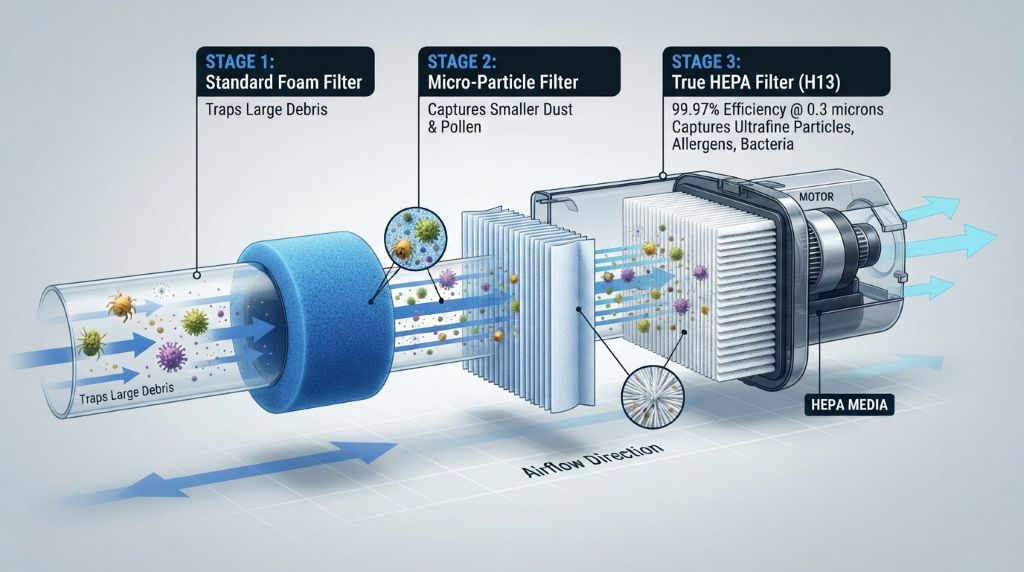
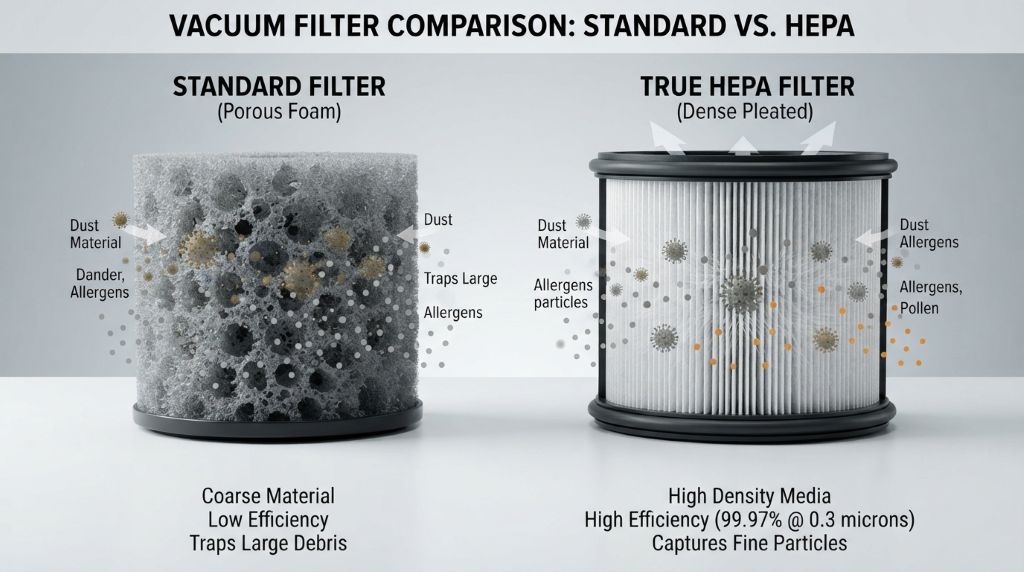
Most budget vacuums use simple filtration stages. A mesh or foam pre-filter catches large debris before it reaches the motor. Then a basic exhaust filter, usually paper or felt, catches medium dust. This setup protects the machine but cleans the air only lightly.
The pre-filter has one job. It stops large particles from scratching or jamming the motor. Consequently, it sees heavy dust loads and clogs first. Most pre-filters are washable foam or mesh cylinders.
Washable filters offer real savings. A foam filter rinses clean under cold water and lasts for years. Therefore, owners skip the replacement filter aisle entirely. However, washable filters carry one strict rule. They must dry fully, usually for 24 hours, before going back in.
A damp filter causes multiple problems:
- Dust turns to mud and blocks the pores quickly.
- Trapped moisture grows mold inside the machine.
- The motor pulls damp air and strains itself.
Paper and felt filters work differently. These are disposable and cannot touch water. Instead, replace them on a schedule, typically every 1 to 3 months with normal use. Meanwhile, tap them gently against a trash bin between changes to shake off loose dust.
Therefore, standard filtration suits homes without allergy concerns. It keeps the vacuum healthy at low cost. However, anyone with asthma, pets, or dust sensitivity should look further up the filtration ladder.
HEPA Filters and What They Actually Trap
HEPA stands for High Efficiency Particulate Air. It is a tested standard, not just a marketing word. To qualify, a filter must trap 99.97 percent of particles that measure 0.3 microns. This threshold matters because 0.3 microns is the hardest size to catch.
HEPA filters achieve this through dense, pleated glass fiber mats. The fibers catch particles in three ways. Large particles hit a fiber and stick. Mid-sized particles get stuck as they curve around fibers. Meanwhile, the tiniest particles bounce against air molecules until they touch a fiber and stick.
Here is what a true HEPA filter stops:
- Pollen, which measures 10 to 100 microns.
- Dust mite waste, around 10 microns.
- Pet dander, often 1 to 10 microns.
- Mold spores, typically 3 to 40 microns.
- Bacteria, mostly 0.5 to 10 microns.
Consequently, HEPA filtration helps allergy and asthma sufferers the most. According to the American Academy of Allergy, Asthma and Immunology, reducing airborne allergen exposure eases symptoms for sensitive people. A HEPA vacuum plays a real part in that reduction.
However, buyers must watch for fake claims. Some boxes say “HEPA-type” or “HEPA-style.” These words mean nothing certified. Look for true HEPA labels that state the 99.97 percent rating at 0.3 microns.
Additionally, HEPA filters need replacement, not washing. A true HEPA filter cannot be rinsed because water mats the fibers. Most last 6 to 12 months with normal use. Therefore, factor the replacement cost into your purchase decision.
Sealed Systems: The Part Sellers Never Mention
A certified filter means little if air leaks around it. Many vacuums hold a HEPA filter but leak dusty air through unsealed joints. Consequently, the exhaust bypasses the filter entirely.
This is why the whole system design matters more than the filter grade. A sealed system forces every air molecule through the filter path. Sealed vacuums use gaskets at every connection point. Additionally, their bodies pass leakage tests before shipping.
Here is how sealed and unsealed systems differ:
- Sealed system: all exhaust passes through the HEPA filter.
- Unsealed system: some air escapes through joints and seams.
- Filter rating only counts for air that actually reaches the filter.
Therefore, ask one question before buying. Is the whole system sealed, or just the filter certified? Manufacturers of premium allergy-focused vacuums advertise sealed systems explicitly. Meanwhile, budget models with HEPA labels often skip sealing to cut costs.
You can spot a well-sealed machine without test equipment. Sealed vacuums list a “sealed system” claim on the box or spec sheet. Additionally, they often smell neutral during use, because almost no dust escapes.
Consequently, allergy sufferers should treat sealing as a requirement, not a bonus. A true HEPA filter in a leaky body performs no better than a cheap foam filter. The filter and the body must work as one unit.
Multi-Stage Filtration and Cyclonic Systems
Modern vacuums rarely rely on one filter. Instead, they stack filtration stages in sequence. Each stage catches progressively finer dust. Consequently, the final filter faces a much lighter load.
A typical multi-stage setup looks like this:
- Cyclone or bag stage catches large and medium debris.
- A foam or mesh pre-filter catches finer dust before the motor.
- The motor exhaust passes a micro or HEPA filter.
- Clean air exits through the final exhaust vent.
Cyclonic vacuums add a clever first stage. Their spinning cones fling most dust into the bin before air reaches any filter. Therefore, filters in cyclonic machines clog slower than filters in bagged machines. However, the finest particles still reach the filters eventually.
Bagged vacuums use the bag itself as a filtration stage. Good bags carry multi-layer materials rated as micro filters. Additionally, premium bags include a hygiene seal that closes the opening when you remove them. Consequently, disposal stays dust-free.
Multi-stage filtration changes your maintenance routine. Each stage needs care on a different schedule:
- Cyclone unit: rinse monthly and dry fully.
- Foam pre-filters: rinse monthly with cold water.
- Micro filters: replace every 3 to 6 months.
- HEPA filter: replace every 6 to 12 months.
Therefore, write the schedule down or set phone reminders. Skipped maintenance quietly kills airflow, which reduces suction long before the filter looks dirty.
How to Choose and Maintain the Right Filtration
Your health needs should drive the filtration choice. Homes without allergies can save money with standard filtration. Meanwhile, allergy sufferers, pet owners, and families with infants need sealed HEPA systems.
Use this quick matching guide:
- No allergies: standard washable filtration works fine.
- Mild allergies: micro filtration with regular filter changes.
- Asthma or strong allergies: sealed system with true HEPA.
- Pet homes: HEPA plus cyclonic pre-separation.
- Renovation dust: HEPA with frequent filter changes.
Maintenance keeps any system honest. Even a sealed HEPA vacuum weakens when filters clog. Therefore, build a simple monthly routine and follow it.
Follow these steps:
- Empty the bin or replace the bag after major sessions.
- Rinse washable pre-filters monthly with cold water only.
- Dry all washed parts for a full 24 hours.
- Replace disposable filters on schedule, not when they look dirty.
- Check gaskets and seals for cracks twice a year.
Additionally, never run a vacuum without its filters, even briefly. Unfiltered dust reaches the motor and grinds the bearings. Consequently, a five-second test can cause months of motor wear.
Finally, store spare filters before you need them. Buying filters in packs keeps costs low and prevents skipped changes.
Frequently Asked Questions
Are HEPA vacuums worth the extra cost?
Yes, if anyone in your home has allergies or asthma. True HEPA traps 99.97 percent of particles down to 0.3 microns. However, standard filtration works fine for homes without health concerns.
Can I wash a HEPA filter instead of replacing it?
- Water mats the glass fibers and destroys the filter’s rating. Replace HEPA filters every 6 to 12 months instead. However, washable foam pre-filters in the same vacuum are rinse-safe.
What does “HEPA-type” mean on a filter box?
It usually means an untested filter that mimics HEPA materials. Only true HEPA carries the certified 99.97 percent rating at 0.3 microns. Treat “HEPA-type” and “HEPA-style” as marketing words.
How often should I change vacuum filters?
Rinse washable filters monthly. Replace paper pre-filters every 1 to 3 months, micro filters every 3 to 6 months, and HEPA filters every 6 to 12 months. Heavy use shortens all these timelines.
Does a sealed system really matter that much?
Yes. Air that leaks around the filter never gets cleaned. A certified HEPA filter in a leaky body performs no better than a basic filter. Look for explicit sealed system claims.
Conclusion
Filtration decides what your vacuum does with the dust it collects. Standard filters protect the machine at low cost. Meanwhile, true HEPA filters in sealed systems protect your lungs, trapping 99.97 percent of the finest particles. Remember the two-part rule. The filter grade matters, and the sealing matters just as much. Therefore, check both before buying. Additionally, match the filtration level to your real health needs instead of paying for features you will not use. If you mainly clean hard surfaces, learn how to use a canister vacuum for hardwood floors without streaks for cleaner, more consistent results.
Maintenance completes the picture. Clogged filters choke suction and release dust back into the room. Therefore, rinse the washable stages monthly and replace the disposable stages on schedule.
Check your vacuum today. Look up its filter type, note the replacement schedule, and inspect the current filter’s condition. Ten minutes of attention now keeps your air cleaner and your suction stronger for months to come.