You may be looking to change some of the doors in your kitchen. Replacing old kitchen doors for new can seem like a straightforward job. However, it is surprising how many problems arise even before the new doors are fitted. Here are the common errors that occur and some simple things to check in order to avoid them.
Ignoring Existing Hinge Positions
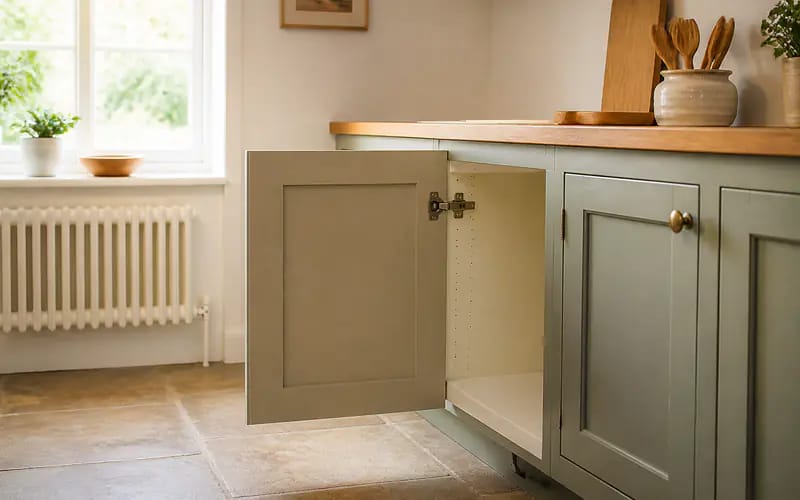
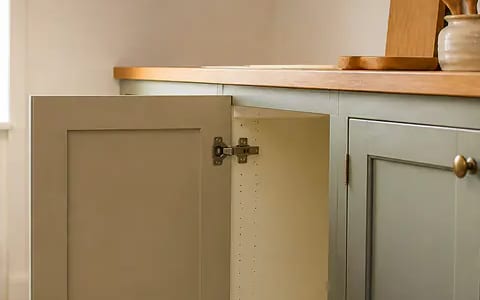
If the old doors have hinges in unusual places it’s very easy to fail to note these when ordering the new doors and subsequently the old drill holes could be visible around the edges of the new doors. This is particularly relevant for determining the overlay type (fully covering, partially covering or flush fit within the cabinet) of the new doors. It is strongly recommended that you take a photo of an open door and hinge together to check against the new design.
Forgetting Integrated Appliance Doors
The doors for the integrated appliances (such as a dishwasher, fridge or freezer) are not standard cupboard doors. They require specific fixing brackets to hold the weight of the appliance and to attach to the appliance’s door closing mechanism. These fixing brackets are usually supplied with the appliance and are attached to the fixing plate on the back of the door. When ordering new doors for the integrated appliances for a replacement kitchen, please make sure to inform the supplier that these are for integrated appliances and not standard cupboards. Also check the appliance’s manual or the fixing plate for the correct type of bracket.
Not Checking Door Thickness
Many doors are made to specific standards and are therefore supplied to certain dimensions (e.g. 18mm or 20mm thick). A change of a few millimeters can mean that the old handle screws won’t fit and that the old hinge cups will protrude or sink into the door leaf. It’s worth checking the standard for your type of door before ordering. For most timber doors this would be H3 (18mm) or H4 (20mm).
Choosing Colour From a Tiny Swatch
Colours look very different under a shop’s fluorescent lighting than they do under your own kitchen lighting. Be sure to ask for a large sample (e.g. A4 size) to test out under your own cabinet lighting at different times of day including evening when the room is lit only by your cabinet lighting. This will give you a much more accurate impression of the final colour than a tiny swatch or even a shade’s colour name.
Overlooking Matching Trim
End panels, pelmets, cornices and plinths all form part of the overall look of your kitchen and need to be replaced at the same time as your kitchen doors. This is often the case where the existing trim was ordered at the same time as the doors and were supplied in a specific colour or finish. Even if the same colour name is available for new doors, the finish may have changed over time, resulting in new doors not looking quite right against your old trim. It is therefore very important to check what existing trim you have and can be replaced or refinished and order this at the same time as your new kitchen doors.
Assuming the Carcass Is Square
Cabinets will have settled over time. Floors may have sunk slightly and walls may have moved. All of this means that corners which were once perfectly square can now be slightly out of true. New doors will reveal all these problems as uneven reveals along the top of a pair and uneven gaps down the sides. It is worth checking your cabinetry with a spirit level and measuring with a tape before ordering your new doors. This will highlight any problems that can be addressed or packed out before you order, allowing for any settling afterwards.
Reusing Handles Without Checking Spacing
When replacing the doors to your kitchen it is a common practice to retain the existing handles, saving money. The spacing between the screws for the handles’ attachment to the doors is known as the centre distance. This measurement varies between different handles. Ensure that you measure the existing screw holes and pass this on to the supplier, or alternatively request the doors to be pre-drilled prior to delivery.
More on Replacement Kitchen Doors can be found at Happy Doors.
Underestimating Hinges and Hardware Costs
Hinges, soft-close mechanisms, hinge lubrication, and cabinet door fixing brackets are typically supplied by a different supplier to the replacement kitchen doors. Their cost and lead time are frequently underestimated. Even soft-close hinge suppliers can experience longer lead times when orders are placed by a different supplier of replacement kitchen doors. Thus these items must be costed and a lead time allowed on top of that of the doors before ordering.
By ensuring that you have the correct information before ordering, you can avoid a second trip to collect or be delivered items, and a great deal of frustration once your doors are delivered and you are ready to fit them.